|
A
clutch of eggs is the number of eggs a bird lays during one nesting
period. An ostrich may lay more than 50 eggs; a Wandering Albatross
breeds on alternate years and lays only one.
I
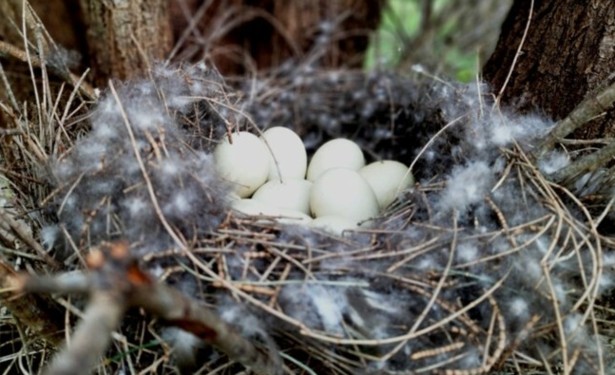
discovered the pictured nest on October 11 (2022) when going for a
stroll near some
sheoaks and experienced a sudden loud flutter as a bird flew past my
face. It happened too fast for me to see the bird. The
nest
was about 1.5 metres above ground, 30 centimetres diameter, and the
eggs numbered at least ten. The bird might have been a duck because
ducks are said to lay from 8 to 18 eggs although this varies with
species (the Australian wood duck lays 8-12 eggs). I'm also not sure
whether ducks
build nests in trees.
https://en.wikipedia.org/wiki/List_of_birds_of_Kangaroo_Island,_South_Australia
https://en.wikipedia.org/wiki/Bird_egg
https://petkeep.com/how-many-eggs-do-ducks-lay/
https://www.allaboutbirds.org/guide/search
I wrote the above in
2022 but have now (2026) consulted the artificial intelligence COPILOT.
I provided Copilot information on the egg-size (5 cm), surrounding
vegetation (sheoaks), distance from water, etc.
Copilot readily gets pedantic and repetitious, therefore I have
condensed the analysis
it supplied:
1
From the nest size, egg count, nest structure, height,
and location (Nepean Bay,
Kangaroo
Island),
the species is almost certainly a duck,
most likely Pacific Black Duck (Anas
superciliosa)
or Australian Wood Duck / Maned
Duck (Chenonetta
jubata). No passerine or raptor on Kangaroo Island
lays anything
close to 10 eggs or
builds a 30 cm twig nest in
a low
tree.
Your
photo shows:
A large nest (~30 cm
diameter)
Built
of twigs and soft lining
In a tree,
about 1.5 m above ground
Containing
at least 10 smooth, pale eggs
Only ducks
match your egg
count.
2. Do ducks ever nest in trees?
Several
Australian duck species are tree‑nesters.
The Australian Wood Duck (Maned Duck) is
particularly
known for nesting in tree hollows, on branches and artificial platforms
up to several metres high. Pacific
Black Ducks usually nest on the ground but also use low trees,
stumps, or dense vegetation
when available. Given your nest is 1.5 m high, both species remain
strong candidates.
3. Does the nest structure match ducks?
Yes. Ducks
typically build:
A large, messy bowl of twigs, grass, and down
30 cm
diameter is
normal
Eggs are smooth, pale cream/white, exactly as in
your photo
Clutch size 8–14 eggs is
typical for
both Pacific Black Duck and Australian Wood Duck. No other
KI bird builds a nest like this with so many eggs.
4. Does the location fit?
Nepean Bay has
Wetlands;
Coastal
vegetation; Plenty
of tree perches and
safe nesting spots.
Both Pacific Black Ducks and
Australian Wood Ducks are
common there.
5. Final identification
Most
likely: Australian Wood Duck / Maned Duck (Chenonetta jubata)
Common
on Kangaroo
Island
Tree‑nesting
species
Clutch
size 8–14 eggs
Pale
eggs
Nest
size matches
Second possibility: Pacific Black Duck (Anas
superciliosis)
Very
common
Clutch
size 8–13 eggs
Pale
eggs
Occasionally
nests in low trees
Your
extra details — sheoak habitat, white eggs ~5 cm, large twig nest, 200–400 m from water —
tighten the
identification. The evidence converges on one species.
Australian Wood Duck
(Maned Duck) — Chenonetta jubata
·
Clutch size:
8–14 eggs is
normal
·
Egg size:
49–54 mm long
(your estimate of 5 cm is spot‑on)
·
Egg colour:
white to creamy
white
·
Nest height:
often 1–3 m above ground
·
Nest type: a large bowl of twigs,
grass, and down,
not a hollow
·
Nest location:
frequently in sheoaks, eucalypts, or farm trees
·
Distance to
water:
commonly nest hundreds of metres
from ponds or
the coast
·
Behaviour:
females flush
suddenly and silently when disturbed — exactly what you saw
Second
possibility: Pacific Black
Duck Anas superciliosa) is less likely because:
They
prefer ground nests in
dense
vegetation
Tree
nests do
occur but are less common
Their
nests are
usually more grass/down‑lined and
less twig‑built
They
tend to nest closer to water
than Wood Ducks
Your
nest’s height, twig structure,
and sheoak location all
favour Wood
Duck:
Diameter ~30 cm
Twigs forming the
outer
bowl
Soft lining (down,
plant fibres)
Smooth white eggs,
~5 cm
Large clutch (10+)
No other Kangaroo
Island
bird produces this combination.
Australian Wood Duck (Maned Duck)
— Chenonetta
jubata
Classifcation:
Kingdom: Animalia
Phylum: Chordata
Class: Aves
Order: Anseriformes
Family: Anatidae
Genus: Chenonetta
Species: C. jubata
References:
https://copilot.microsoft.com
(2026)
https://en.wikipedia.org/wiki/Australian-wood-duck
[includes photos]
|