An hour later they were still entangled and had moved about a metre.
A return visit in late afternoon to where they were last seen in the morning failed to find them.
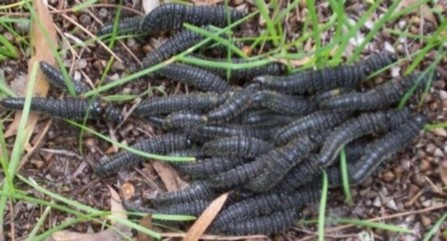
Previously on this website I misidentified the creatures, but have now asked Copilot (Artificial Intelligence) which provided the following information:
They
are almost certainly
processionary caterpillars –
the larvae of
the bag‑shelter moth (Ochrogaster
lunifer) – and your photo matches their behaviour and appearance
unusually
well:
- They occur on Kangaroo
Island and
across coastal/inland
- They move in tight groups, either in a head‑to‑tail line or a defensive bunch when disturbed.
- They can appear suddenly and vanish within hours, because they leave their silk nest at dusk, forage, then return at dawn.
- Large numbers occur together – sometimes up to 200 individuals in a single procession.
- If disturbed, they curl
into a compact cluster, exactly like the
bunch you photographed.
Your image shows
dark, cylindrical, segmented larvae tightly massed on the ground.
Although
processionary caterpillars are often shown as hairy, their hairs can be
much
less obvious when the group is tightly bunched or when individuals are
early‑instar
or dust‑coated.
Classification (as far as possible)
Order: Lepidoptera
Family: Notodontidae
Genus: Ochrogaster
Species: Ochrogaster lunifer (bag‑shelter moth)
Behaviour match
Processionary caterpillars:
Live communally in a silk "bag" nest.
Leave the nest at night to feed.
Travel across ground in groups when searching for a new food tree.
Form tight defensive clusters when disturbed.
This
is exactly
the pattern you described: two groups
several metres apart, moving slowly as a bunch, then gone hours later.
⚠️ Important caution
These caterpillars shed millions of barbed hairs that can cause:
Severe skin irritation
Eye injury
Respiratory problems
Miscarriage in horses that ingest shed hairs on pasture
Avoid touching
them or disturbing their nest.