|
RED BANKS
The Red Banks are cliffs
composed
of
"laterite", about ten to twenty
metres high,
stretching
along the coast or beach for about 10km, starting 10km east of Western
Cove.
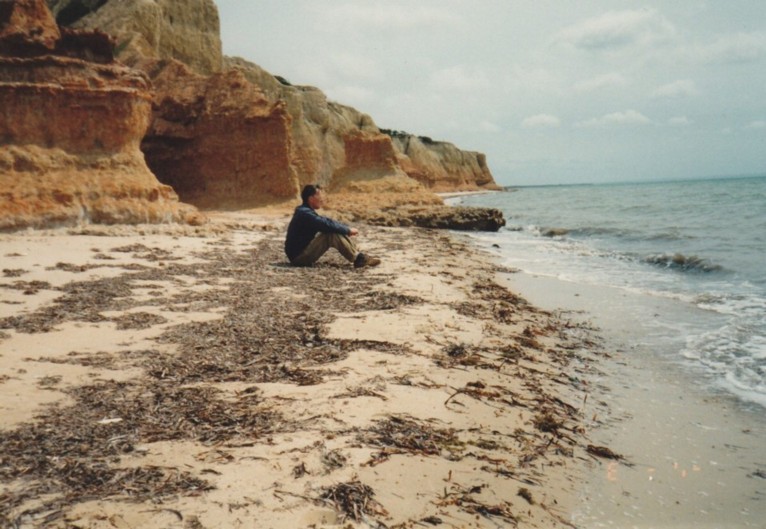
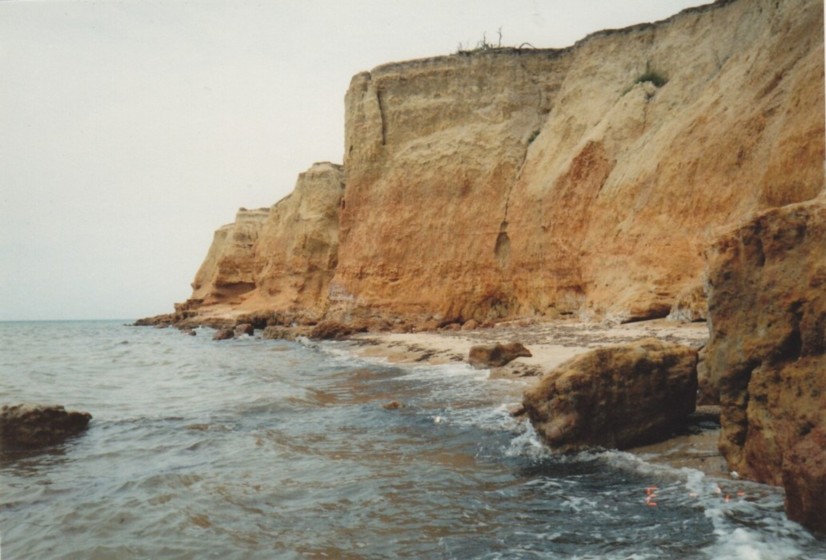
Laterite is an iron rich material that formed about thirty million years ago when Kangaroo Island was sub tropical. The land above the cliffs is treeless due to poor soil. Near the top the cliffs are grey; further down this becomes various shades of orange or reddish brown. At the base of the cliffs are small coves and beaches and a few caves. The Red Banks can be reached by a 10km walk along the beach from Western Cove or more quickly by car via Red Banks Road and Flea Castle Road. Some sections of the cliffs are close to the sea and a walk below them along the beach at low tide could cut off one's return when the tide rises and result in wet feet. |
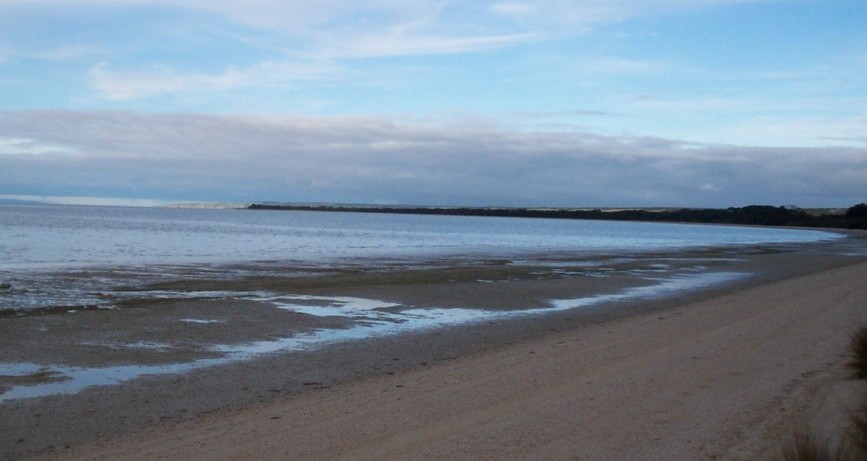
Above:
The Red Banks as seen from Western Cove Beach, only
just visible half way between left and centre
Below:
Two photos showing part of the Red Banks close up
The following is from Wikipedia:
|
Laterite is
a soil and rock type rich in iron and aluminium and is commonly
considered to have formed in hot and wet tropical areas. Nearly all
laterites are of rusty-red coloration, because of high iron oxide
content. They develop by intensive and prolonged weathering of the
underlying parent rock. Tropical weathering (laterization) is a
prolonged process of chemical weathering which produces a wide variety
in the thickness, grade, chemistry and ore mineralogy of the resulting
soils. The majority of the land area containing laterites is between
the tropics of Cancer and Capricorn.
Laterite has commonly been referred to as a soil type as well as being a rock type... Historically, laterite was cut into brick-like shapes and used in monument-building. After 1000 CE, construction at Angkor Wat and other southeast Asian sites changed to rectangular temple enclosures made of laterite, brick, and stone. Since the mid-1970s, some trial sections of bituminous-surfaced, low-volume roads have used laterite in place of stone as a base course. Thick laterite layers are porous and slightly permeable, so the layers can function as aquifers in rural areas. Locally available laterites have been used in an acid solution, followed by precipitation to remove phosphorus and heavy metals at sewage-treatment facilities. Laterites are a source of aluminium ore; the ore exists largely in clay minerals and the hydroxides, gibbsite, boehmite, and diaspore, which resembles the composition of bauxite. In Northern Ireland they once provided a major source of iron and aluminium ores. Laterite ores also were the early major source of nickel. Francis Buchanan-Hamilton first described and named a laterite formation in southern India in 1807. He named it laterite from the Latin word later, which means a brick; this highly compacted and cemented soil can easily be cut into brick-shaped blocks for building... Laterite covers are thick in the stable areas of the Western Ethiopian Shield, on cratons of the South American Plate, and on the Australian Shield. In Madhya Pradesh, India, the laterite which caps the plateau is 30 m (100 ft) thick. Laterites can be either soft and easily broken into smaller pieces, or firm and physically resistant. Basement rocks are buried under the thick weathered layer and rarely exposed... See the complete article at: https://en.wikipedia.org/wiki/Laterite.htm |