SHEEP REARING
Sheep can be reared free range on paddocks or inside large sheds or barns.
At Western Cove the few properties of a century ago were large which
made free range sheep keeping appropriate.
Land holders could introduce sheep with relatively little investment and make it into a profitable business. They needed to know about sheep pregnancy, lamb care, weaning, culling, dipping, vaccination, other health care, and marketing.
Sheep produce wool, skins/parchment, meat, milk and manure, and formed a dependable source of income to the KI economy.
The advantages of sheep farming on KI were that sheep:
Land holders could introduce sheep with relatively little investment and make it into a profitable business. They needed to know about sheep pregnancy, lamb care, weaning, culling, dipping, vaccination, other health care, and marketing.
Sheep produce wool, skins/parchment, meat, milk and manure, and formed a dependable source of income to the KI economy.
The advantages of sheep farming on KI were that sheep:
- Do not require expensive outlay; the foundation stock is relatively cheap.
- Multiply rapidly. Ewes are pregnant for five months, therefore may lamb twice each year, and produce from one to three lambs per birth. Sheep are full grown at two years and live a further nine or ten years.
- Do not require sheds or barns on KI due to the mild climate.
- Require less labour than other kinds of livestock.
- Can graze without supervision when pasture is fenced, and do not need to be fed from troughs.
- Eat a
greater variety of plants than other livestock and therefore help to
control weeds and other unwanted plants. A German textbook says: "Of
middle European plants it eats 237 types and rejects 141." (Bardorff, W. 1950 Brehms
Tierleben,
- Do little damage to trees.
- Are adaptable and hardy and can coexist with other livestock.
- Have access to fresh water at Western Cove due to the high water table.
- Have transportation to markets by ship.
- Are
relativlely safe on KI since there are no dingoes.
Sheep farming around Western Cove has declined. I don't see many sheep
nowadays but occasionally hear their distant
bleating on calm, quiet nights.
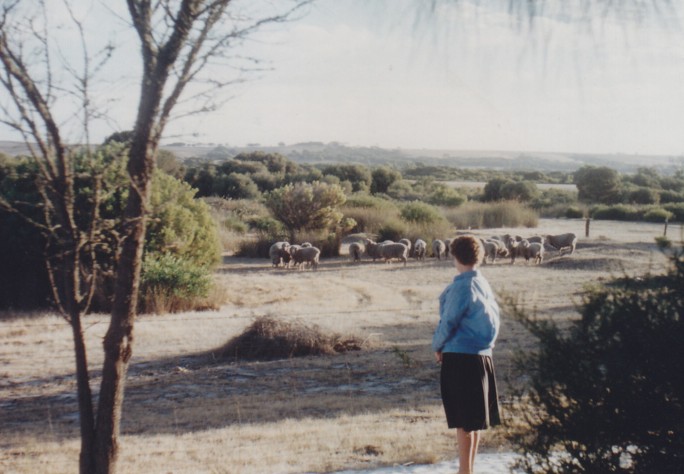
A tourist at Western Cove
observing sheep from Sea Vista Road in 1995